
Stop Bloomfield's Corruption Machine—Your Vote on June 2nd Is Critical
By Dr. Satenik Margaryan

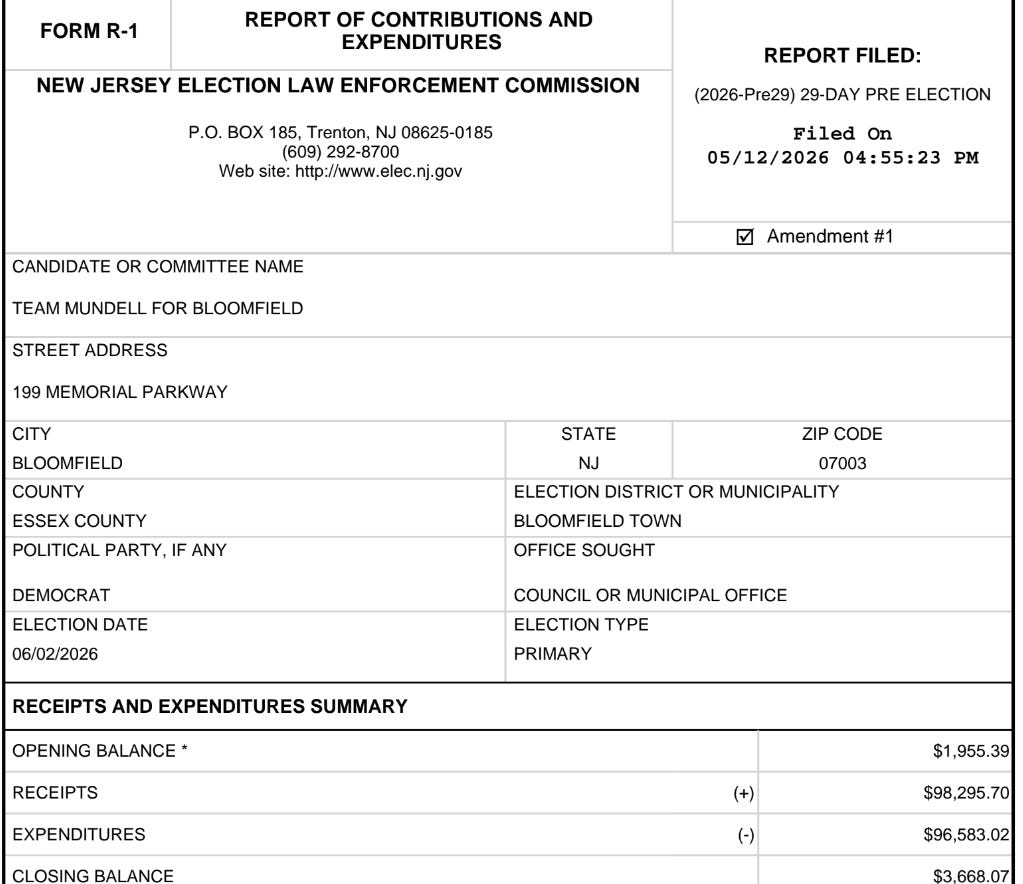
We finally have a window on who supports Team Mundell: Gonzalez, Martinez, and Cruz. The Joint Committee Report published on May 13th offers a rare opportunity to understand whose interests will shape Bloomfield’s future.
The Scheme
Imagine this: The town attorney, the town auditor, the town’s engineering consultants, and the town’s insurance brokers all contribute to a single campaign for municipal council candidates. The town’s biggest developer joins in. Within weeks, those candidates are on the ballot asking residents to vote them into positions where they’ll vote on contracts—contracts that will directly benefit the people bankrolling their campaigns.
This isn’t a hypothetical. It’s happening in Bloomfield right now.
A campaign finance report filed in May 2026 reveals a textbook pay-to-play scheme. The town attorney contributed $6,000—$800 over the legal limit. The town auditor gave $5,500—$300 over the limit. The town’s engineering consultants and insurance brokers maxed out their contributions. All of these individuals and firms hold lucrative contracts with the municipal government these candidates seek to join.
The question Bloomfield residents face: Is this legitimate politics, or a coordinated effort to elect a council that will serve the interests of those funding the race?
How Murphy Made This Legal
In April 2023, Governor Phil Murphy signed the “Elections Transparency Act” with great fanfare. Progressive groups and good government advocates urged him to veto it. He ignored them.
Despite its name, the law made corruption easier. The state doubled campaign contribution limits from $2,600 to $5,200 per candidate per election. More damaging still, ELEC’s statute of limitations for enforcement was shortened from ten years to two years—meaning old violations become unreviewable and enforcement becomes nearly impossible.
Translation: town contractors could now legally give twice as much money to candidates who would vote on their contracts, and regulators would have half the time to investigate.
Opponents warned the new regulations would worsen election fairness by allowing government contractors to donate to political campaigns. They were right.
The Full Network
The ELEC filing reveals a coordinated fundraising effort from people and firms with deep financial ties to Bloomfield government:
Khalifah Shabazz (Town Attorney): $6,000 — giving to candidates who will oversee her role
Steven Wielkotz (Town Auditor): $5,500 — the auditor contributing to those he’s supposed to audit
T & M Associates (Town Engineering Consultants): $6,000 — the firm Bloomfield pays for engineering work
Steve Martino (Attorney): $3,500 — years of township legal appointments
Fairview Insurance Agency Associates (Town Insurance Brokers): $3,500
William Colgan (Major Developer): $2,500 — the person most affected by council zoning decisions
Eagle Rock (Health Insurance Fund Manager): $1,500. In September 2025—eight months before this filing—Acting Comptroller Kevin Walsh released a 34-page report documenting an “unauthorized covert takeover of a core public function by a private entity—and a serious risk to public trust and public dollars.”
And so many more, so do check the report on your own!
Several exceeded even the newly raised $5,200 per-election limit. All hold contracts with the municipal government.
What We Don’t Know Yet
Bloomfield’s 2026 township budget has not been released. That’s where the real story lives.
That’s where we’ll see:
How much taxpayer money flows through the health fund managed by Eagle Rock
What contracts are renewed or awarded to T & M Associates
How much the town pays the attorneys who funded this campaign
What development decisions favor William Colgan
Whether the auditor and town attorney continue in their positions (and the chances are they will).
To be continued—when the budget is finally released.
The Choice on June 2nd
Bloomfield residents can vote for candidates funded by a network of town contractors and insiders, or candidates who refuse this money and commit to transparency.
The ELEC filing makes the choice clear.
Vote on June 2nd. Demand better!
Allowing municipal contractors to donate to the mayor's campaign or administration creates a conflict of interest known as "pay-to-play". Even if there is no explicit quid pro quo, it invites the perception that public contracts are being awarded as favors for campaign cash rather than through merit and competitive bidding. Many states and municipalities (such as New York City and Chicago) have strict "pay-to-play" laws that make it illegal for city vendors, contractors, and their executives to donate to the campaigns of the officials who oversee their contracts.
Thank you…. Clear, concise and to the point.