
🚪 Two Doors, Same Building, No Exit
Six of every ten dollars of Bloomfield's tax increase spent on health insurance


We were told the state plan was too expensive. We left. Our costs went up 28% anyway — and the alternative turned out to be run by the same people.
Last July I wrote that Bloomfield’s budget was a mirage. This year the town isn’t even pretending. The 2026 municipal budget raises the tax rate 12.25%, from 1.331 to 1.494. The average homeowner pays $584.29 more — about $48.69 a month, nearly three times last year’s increase.
The township’s explanation is four words long: costs “outside of local control.”
Sixty-one and a half percent of that increase is health insurance. That number is on the town’s own slide. And the story behind it is not a story about forces beyond anyone’s reach. It is a story about who gets paid, and who decides.

📊 The one number that explains the budget
By the township’s own presentation, health insurance accounts for $5,660,000 of the appropriations increase — 61.5% of the total. Liability insurance adds $451,000. Pensions add $1,239,116.
The state-certified budget book puts the insurance appropriation at $20,780,000 rising to $26,670,000: up $5,890,000, or 28.34%, in one year.
Six of every ten new dollars you are being taxed is health insurance. Everything else in this budget is a footnote.
🚪 The choice that wasn’t
Bloomfield does not participate in the State Health Benefits Program. Sheet UFB-8 confirms it: no SHBP medical, no SHBP prescription drug coverage.
The reason usually given is that the state plan is too expensive — and the state plan is in serious trouble. The State Health Benefits Commission approved a 36.25% increase for the Local Government group in 2026, following 16.4% in 2025, 7.4% in 2023, and 20% in 2022. Roughly 115% over five years. The state’s own actuaries have described it as a death spiral: rates rise, healthier employers leave, the remaining pool gets sicker and costlier, rates rise again. About 560 local government entities remain, down from roughly 700 four years ago. Treasury has projected a negative reserve balance of some $209 million.
So Bloomfield went elsewhere. Our employees are covered through the Metropolitan Health Insurance Fund, a joint self-insurance pool administered by PERMA Risk Management Services — 22 public entities, 5,400 employees, 13,000 members, an annual budget of $106–126 million. Bloomfield’s roughly $22 million is close to a fifth of the whole fund.
Here is what residents were told this would buy. On the fund’s own website, under Testimonials, attributed to [former ]Councilwoman Jenny Mundell: the fund provides Bloomfield, its library, and their employees with “premium stability year over year,” making the benefits budget “much more predictable.”
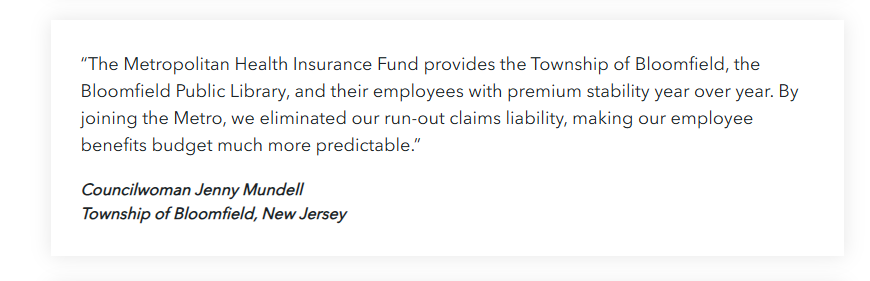
Now the result: 28.34% in one year.
That is not stability. That is not predictability. That is not, by any ordinary use of the words, a more cost-effective alternative.
🧾 The comparison nobody has produced
The defense of that number is always the same: yes, 28% — but the state plan went up 36%, so we came out ahead.
Ask for the document.
The 36.25% is a pooled statewide average for the Local Government Employer Group. It is not a rate anyone quoted to Bloomfield. Nobody has published what the SHBP would actually have charged this town, with this workforce, with 454 retirees on the books. As far as the public record shows, that comparison has never been run and never been disclosed.
Which means “we beat the state plan” is not a finding. It is a claim about a hypothetical, made by the people who chose the alternative, marketed on the alternative’s own website.
Residents are being asked to accept a 28% increase on the strength of a number that has never been shown to them.
And there is a second comparison that has never been shown. The Metropolitan Fund covers 22 entities. If the fund’s overall costs rose less than 28.34%, then Bloomfield did worse than the pool it joined — and the stability argument collapses entirely. The fund publishes financials and meeting minutes. That number exists. Nobody at the podium mentioned it.
🐙 Same landlords, different door
Here is what makes this more than a bad renewal.
New Jersey does not negotiate hospital rates for its public plans. It delegates that job to insurers — mainly Horizon and Aetna — who are paid a fee to negotiate and pay claims. Horizon collected roughly $500 million for that middleman role between January 2020 and June 2024. As quoted in NJ Democrat’s most recent article, Chris Deacon, formerly an assistant director at the state Division of Pensions and Benefits, has described the incentive problem plainly: when insurers spend someone else’s money, they have no reason to drive prices down.
Rutgers researchers find 96% of New Jersey hospitals are affiliated with larger systems, and that this consolidation raises prices. The Office of Legislative Services reports hospital charges rising faster than inflation and faster than national benchmarks.
Now the other door. In September 2025, acting State Comptroller Kevin Walsh reported findings from an investigation into three public joint insurance funds: contracts steered to politically connected vendors, procurement law violations, conflicts undisclosed for years. His central conclusion was that Conner Strong & Buckelew and the entity operating as PERMA had never disclosed to regulators that they function as a single business — overlapping employees, shared leadership, writing the rules for contracts and then winning those contracts. Walsh called it a “covert takeover” of a public function by a private entity, and found the arrangement would have given the two firms control over procurement for six joint insurance funds covering nearly 300 government entities.
Conner Strong was founded by George Norcross. A spokesman called the Comptroller’s report factually inaccurate and politically motivated, and noted prior state reviews had found the funds compliant.
Two points of precision. The Metropolitan Fund was not among the three funds Walsh investigated. And the Metropolitan Fund was created in 2020 by Joseph G. DiVincenzo, who serves as its Fund Coordinator, the son of Joseph N DiVincenzo Jr, Essex County Chief Executive who is seeking 7th term in office.
But Metro is administered by PERMA — the firm at the center of those findings. Its membership is a roll call of Essex County and North Jersey: Montclair, West Orange, Irvington, East Orange, Maplewood, Millburn, West Caldwell, Union. Its Executive Committee is chaired by Bloomfield’s mayor.
So this was never a choice between the machine and an escape from it. It was a choice between two structures that route public money through the same brokers, the same administrators, the same carriers, and the same consolidated hospital systems. The state plan collects through Horizon. The fund collects through PERMA. The hospitals get paid either way.
We didn’t escape. We changed doors in the same building — and the second door was held open by people we already knew.
🪑 One person, every chair
There is a reason “outside of local control” is the wrong phrase, and it has a name.
Jenny Mundell chairs the Executive Committee of the Metropolitan Health Insurance Fund. The fund’s own website says so, in plain type, under Executive Committee: Jenny Mundell, Chair, Bloomfield Public Library.
She is also the Mayor of Bloomfield — the township that pays roughly $22 million a year into that fund, close to a fifth of its entire budget.
She sits on the governing body of the entity that provides Bloomfield’s health coverage, and she presides over the governing body that buys it. She represents one taxpayer-funded Bloomfield institution on the fund’s board — the Public Library, which residents fund through a minimum library tax of $2,785,801 this year, itself up 8.78% — while chairing the council of the other.
Then there is the sequence.
As a councilwoman, she gave the fund a testimonial that still sits on its marketing page today, promising Bloomfield employees and taxpayers “premium stability year over year” and a benefits budget that would be “much more predictable.”
As mayor, she took the chair of that fund’s Executive Committee.
As mayor, she introduced a budget in which that fund’s costs rose 28.34% in a single year, driving 61.5% of a 12.25% tax increase.
And as mayor, she told residents those costs are outside of local control.
They are not outside her control. She chairs the body.
That is not an accusation about her motives. It is a contradiction between two of her own public statements, both documented, both still online. Either the mayor has meaningful influence over Bloomfield’s health insurance arrangement — in which case “outside of local control” is not true — or she chairs a fund whose costs she cannot affect, in which case residents deserve to know what the chairmanship is for.
New Jersey's Local Government Ethics Law bars local officials from acting in matters where a direct or indirect financial or personal involvement might reasonably be expected to impair their objectivity. Whether this arrangement crosses that line is not for a Substack to decide — it is for the Local Finance Board. But it is precisely the kind of question a municipal ethics board would exist to examine, which is why I asked this council to create one in May 2026. They did not.
One more disclosed fact, offered without a theory attached: Mayor Mundell is employed as Vice President of Development at RWJ Barnabas Health, New Jersey’s largest hospital system. Development work is charitable fundraising, not pricing, and I am not suggesting she sets hospital rates. But reporting by The New Jersey Democrat documents that RWJ Barnabas employs a striking number of politically connected figures — a former governor’s chief of staff, his deputy, a former executive director of the state Democratic Committee — and the mayor of Bloomfield. Readers can weigh what that pattern means. What is not in dispute is that hospital pricing is the root cause of the largest line in this budget, and that no township document has ever named it.
Mayor Mundell inherited the mayor’s office from Michael Venezia, now Assembly Majority Whip. The fund she chairs was created by Joseph G. DiVincenzo, who serves as its Fund Coordinator. Its membership is a map of North Jersey machine towns.
None of this is illegal on its face. That is rather the point. The system does not require anyone to break a rule. It only requires that the same small group of people hold enough chairs at once — and that when the bill arrives, everyone agrees it came from somewhere else.
👥 What they never mentioned: we insure more retirees than employees
Sheet UFB-8 contains the fact that appears in no slide, no press release, no public statement:
Covered members Annual cost Active employees (net of contributions) 253 ~$8.6 million Retirees 454 ~$13.5 million Total 707 ~$22.1 million
Bloomfield pays about $13.5 million a year to insure people who no longer work here, and $8.6 million to insure people who do.
Retirees are 64% of covered members and 61% of the cost. Employees contribute roughly $1.2 million toward a program grossing over $23 million — about 5%. In Paterson, employees cover about $11 million of an $83 million bill, roughly 13%.
Inside those numbers: 30 retirees in the employee-and-spouse tier cost $114,535 each — more than double the active-employee equivalent. That is the fingerprint of early retirees who are not yet Medicare-eligible.
Nowhere in any public budget document does Bloomfield disclose its total unfunded retiree health liability. That number exists. It is calculated annually. It is not in front of you.
✂️ The savings that feed the cost
The presentation claims $1,043,053 in reductions through attrition. Slide 5 itemizes them: 8 Fire positions, 8 Police positions, 5 DPW, 3 Administration, 1 Finance. Sixteen of twenty-five are public safety — in a budget the press release says protects public safety.
But attrition does not remove those people from the books. Police and firefighters retire early, often in their fifties, years before Medicare. A retiring officer moves from the active column to the retiree column — the column that is already bigger and more expensive.
At the average retiree cost of roughly $29,600, sixteen retirements represent something in the range of $474,000 a year in new retiree health costs, recurring for decades, against $1.04 million in one-year savings. And the state actuary projects local government retirees who left early and are not yet on Medicare could face increases of as much as 36% in 2027.
The cost-cutting measure is a deposit into the cost driver.
💵 What you are paying
By the township’s own presentation, $21.60 of every $100 in monthly municipal taxes goes to employee insurance — second only to police and fire at $27.80.
On the average $5,307 municipal tax bill, that is roughly $1,146 a year, per household.
❓ Questions for July 28
The Budget Hearing and Adoption Meeting is Tuesday, July 28, 2026, at 6:00 PM. The budget is not yet adopted.
Produce the SHBP comparison. What would the State Health Benefits Program actually have charged Bloomfield for 2026 — not the statewide average, our number? Who ran it, and when?
What was the Metropolitan Fund’s overall cost increase for 2026? Did Bloomfield do better or worse than the pool average?
What are PERMA’s administrative and program-management fees, and when were they last competitively bid?
What is the township’s response to the State Comptroller’s September 2025 findings regarding PERMA?
Is the Metropolitan HIF Executive Committee chair position compensated in any form?
Did the mayor participate in any vote or discussion regarding Bloomfield’s membership or renewal in the fund?
What is Bloomfield’s total unfunded retiree health (OPEB) liability?
How much of the $1,043,053 in attrition savings is offset by retiree health costs those same retirements created?
Why does the presentation report a $9.2 million appropriations increase while the certified state budget book reports $10.9 million — and why do slides 10 and 11 report different totals for the same budget?
📌 The point
I am not arguing Bloomfield should rejoin a collapsing state plan. I am arguing that residents were sold a cheaper alternative, were never shown the arithmetic behind that claim, got a 28% increase anyway, and were then told the whole thing is outside local control — by an administration whose mayor chairs the fund in question.
Every one of those things can be true at once. Together they describe something other than bad luck.
“Outside of local control” is not an explanation. It is a way of ending the conversation before anyone asks who is inside it.
📣 What you can do
Come Tuesday, July 28, 6:00 PM. The budget can still be amended.
Demand the SHBP comparison document. If it does not exist, that is the answer.
Demand the OPEB number before adoption, not after.
Ask for a multi-year health insurance projection in every future budget presentation.
Support state reform. A5337 would overhaul State Health Benefits Program governance. Reference-based hospital pricing — pegging rates to Medicare, as Oregon and California have done — was endorsed by Governor Sherrill’s own transition team on fiscal responsibility.
Share this. Then bring someone with you.
🧾 In plain English
If you read nothing else, read this.
1. Your town taxes went up about $584 this year. That’s roughly $49 a month. Last year’s increase was $205.
2. Most of that increase is health insurance. Six out of every ten new dollars go to covering town employees and retirees. That is the town’s own number, from its own slide.
3. Bloomfield doesn’t use the state health plan. The state plan for local governments is failing — its costs have roughly doubled in five years, and towns keep leaving it, which makes it worse for everyone still in it.
4. So Bloomfield buys coverage through a private pool instead. It’s called the Metropolitan Health Insurance Fund. Bloomfield pays it about $22 million a year.
5. That pool was sold to us as stable and predictable. Our costs from it went up more than 28 percent in one year.
6. The town says it beat the state plan. Nobody has shown the math. The 36 percent figure officials point to is a statewide average, not a price anyone actually quoted Bloomfield. As far as the public record shows, that comparison was never run.
7. Switching pools didn’t get us away from anything. Both routes send money to the same hospitals, the same insurers, and the same administrators. New Jersey doesn’t negotiate hospital prices — it pays middlemen to do it. Hospital prices keep rising faster than inflation.
8. The mayor sits on both sides of this. Jenny Mundell chairs the board of the insurance fund. She also runs the town that pays it. She publicly praised the fund, then told residents its costs are “outside of local control.”
9. Bloomfield insures more retirees than working employees. 454 retirees, 253 active workers. We spend about $13.5 million on the retirees and $8.6 million on the people still on the job.
10. Cutting police and fire jobs doesn’t save what it appears to. Eight fire and eight police positions were eliminated by not replacing people who left. Those people don’t disappear from the budget — they move into the retiree health column, which is the more expensive one.
11. The town has never told you what it owes long term for retiree health care. That number is calculated every year. It is not in any public budget document.
12. The budget is not final yet. The hearing is Tuesday, July 28, at 6:00 PM.
Disclosure: I am an elected Democratic District Leader in Bloomfield. Readers should weigh that. Every figure here comes from the township’s 2026 User Friendly Budget, its June 30 budget presentation and press release, or the public records cited.
Sources: Township of Bloomfield 2026 Municipal User Friendly Budget (Sheets UFB-1, 2, 3, 8); 2026 Budget Presentation; township press release, June 30, 2026; NJ League of Municipalities; Office of the State Comptroller, September 9, 2025; Metropolitan Health Insurance Fund; reporting by the New Jersey Monitor and The New Jersey Democrat.
A few additional questions: 1. What is the share ratio for health insurance premium cost between that borne by the township and that borne by the employee / retiree? 2. Before again agreeing to purchase heath insurance coverage through the Metropolitan Health Insurance Fund did the township "shop around" to get premium quotes from at least three other vendors? 3. Why is the township paying for retiree health insurance premiums prior to Medicare eligibility at age 65? 4. Who on the Council receives township paid health insurance and what share of the premium do they contribute? 5. Why is the budget four months late when the "due date" is set by state law and well known to all years in advance? A more timely budget introduction would have permitted better examination and discussion of the facts.
Painstaking research, thank u Satenik. It's interesting how obfuscation is achieved. A few dismissive remarks. They are relying on an overwhelmed citizenry. Almost "don't worry your little heads" with details. Ha, Satenik, you are their worst nightmare.