
The Streets Are Flooding
Outside, Bloomfield is underwater. Inside, the mayor and the majority of the council rushed a 12% tax increase

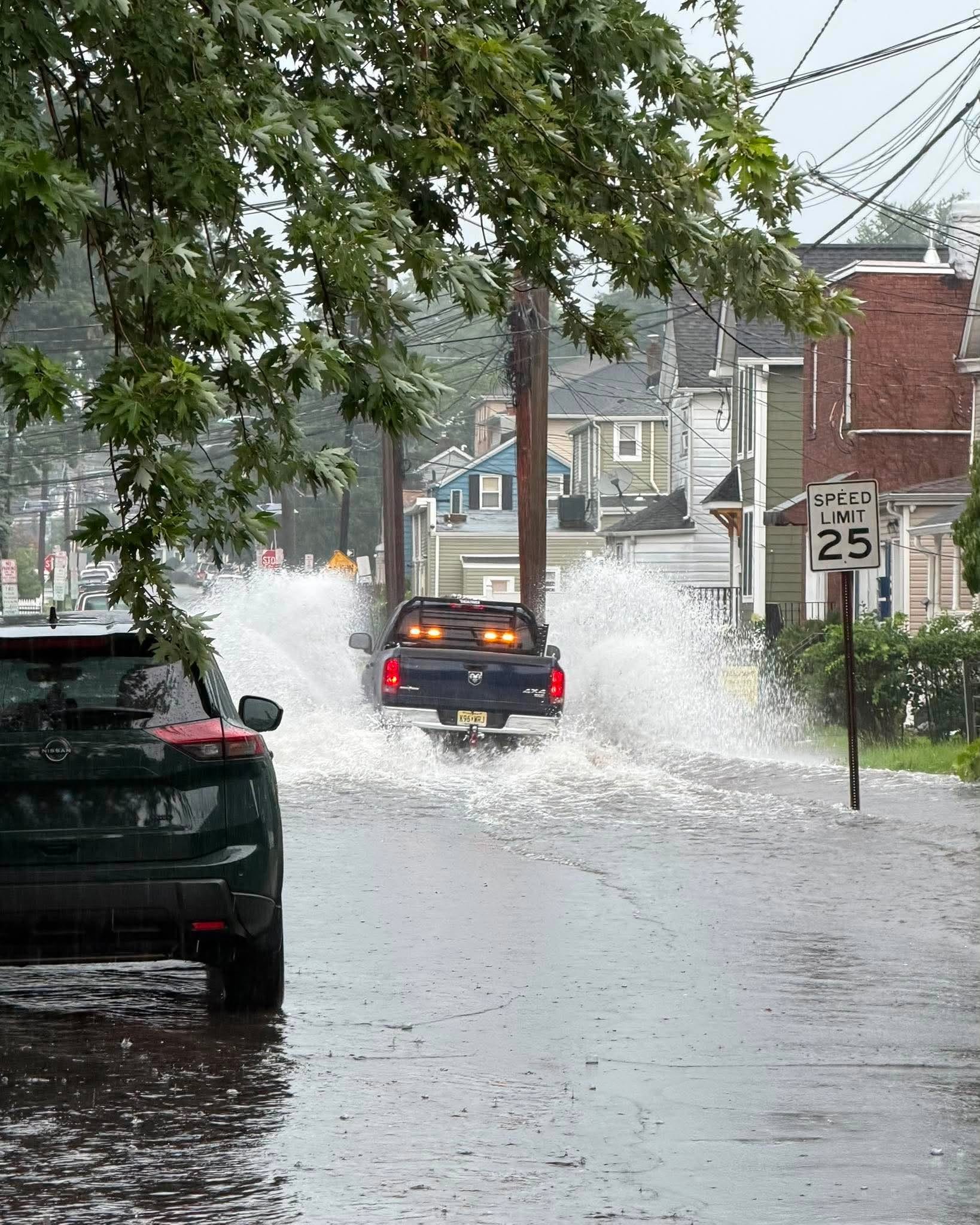
Tonight was the Public Hearing on the Municipal Budget. At 6 p.m., residents, the council, and a few members of the administration — the town administrator, the CFO, the auditor — gathered to adopt it. Outside, it was a rainy evening and streets are flooding across Bloomfield. And here we were, rushing to pass a municipal budget that is already months late — so late that, by any normal calendar, it’s time to start thinking about the 2027 budget. Given how this fiscal year went, I have little confidence next year’s will hurt any less.
But before I get to the adoption meeting, look at this. On May 19th, 2026, at her State of the Town address, the Mayor said this:
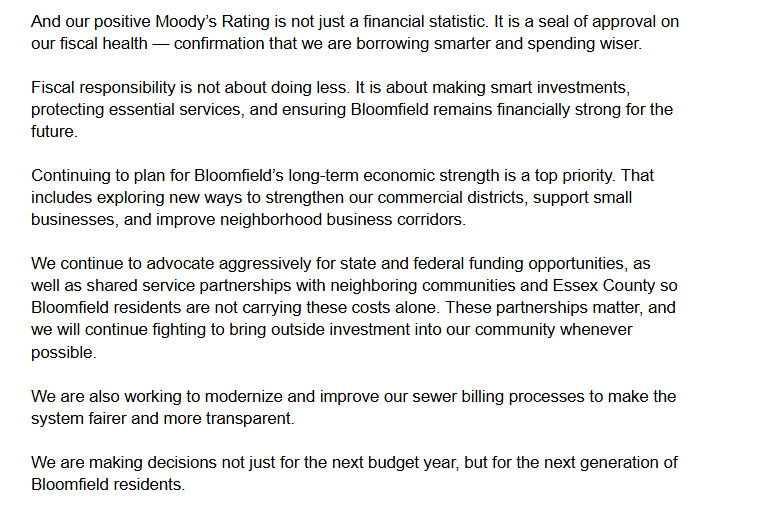
That was May. There was a primary election fourteen days away, and the Mayor’s outlook on Bloomfield’s finances was bright and cheery.
Tonight, on July 28th, she couldn’t remember the percentage of the tax increase her own residents are about to absorb. She had to ask the auditor. Just sit with that for a moment.
The Public Comment
The evening had two distinct comment periods: a non-budget public comment period (other items) held before the ordinance and budget business, and the formal budget hearing public comment period after the budget hearing was opened. Themes recurred across both, but the periods were procedurally separate.
Period One:
Sewer fee fairness and design
The first speaker focused on the recently amended sewer ordinance, arguing it was still rushed and left gaps. Specifically: there are provisions for veterans but no protections or discount for seniors or disabled residents, despite earlier verbal concern for seniors — “nothing in writing, nothing in the ordinance.” She also renewed a repeated argument that the fee should be based on winter-quarter usage, not a 12-month average, because summer usage (watering plants, washing cars, filling pools) doesn’t return to the sewer system, so a true usage-based sewer fee overcharges residents for water that never enters the sewers.
PILOTs and the school-funding gap
The same speaker connected PILOTs to school funding: because PILOT revenue is not shared with the Board of Education, and the BOE is already short at the county level, the shortfall lands on residents through property taxes. She argued PILOT money is dedicated nowhere near the BOE, so abatements compound school underfunding.
Attrition cuts vs. need for more service
A second speaker addressed the proposed attrition cuts — eight police, eight fire, five DPW — and argued Bloomfield needs more, not fewer, police and DPW. She spoke as a resident of a smaller south-end park neighborhood, Halcyon Park, describing reliance on police patrol at night (naming a specific sergeant) because of after-dark visitors at the pond, and on DPW for storm cleanup and maintenance of the park. She warned DPW cutbacks would directly harm small parks and asked the council to reconsider cuts, and — echoing the prior speaker — pointed to PILOTs on large apartment buildings (10–30 year terms) that don’t contribute to schools as the place to look instead.
Sewer fee as a Revolution-era grievance (extended critique)
A third speaker, William Jarrett, delivered a lengthy “no taxation without representation” comment tying the nation’s 250th anniversary to Bloomfield’s “very first sewer bill.” His specific claims:
The sewer-tax rollout was not transparent, rushed, not inclusive of all council members, with no adequate public input.
No independent third-party audit of the sewer study.
No consideration of small-business impact — cited one business with average usage of 7 now facing $2,120/year.
Seniors under the senior freeze now face an additional charge; 51% of the population (renters) wasn’t considered; door open to price gouging.
PILOT recipients weren’t asked to share the burden.
Accused the township of a fiduciary failure by hiring NW Financial, citing SEC/MSRB violations, a privatization history, and a role in Jersey City’s $250M deficit.
Argued the auditor Stephen Wielkotz can no longer ethically audit the 2026 budget having helped form and advocate for the sewer fee.
Alleged OPRA requests were withheld, no budget alternatives were presented, no future cost modeling, no rate cap, no safeguards against fund sweeps, and that billing based on past-quarter usage rather than the July 1 effective date makes it retroactive despite assurances it wouldn’t be.
Closed by charging the delay of the second reading served political interests — that the slate “would not have survived the primaries had you met your deadlines.”
PERIOD TWO — Formal budget hearing public comment
Before the second public comment opened, the town administrator framed the budget as fiscally responsible, citing cost drivers “outside township control” (health benefits, pensions, contractual obligations, casualty insurance) and cost-saving measures (hiring freezes, efficiencies). The auditor then explained the surplus: the township ended 2025 with ~$9,148,000 in surplus and is using $7.3M of it; he argued 2026 operations can regenerate at least $7.3M to end the year near $9.1–9.2M again. He noted the state Division of Local Government Services did a “deep dive” review and emailed approval to adopt at about noon that day, and that the township is appropriating less in 2026 than it spent in 2025 due to unfilled/attritioned positions.
Health insurance — was the renewal actually shopped?
The first speaker, Stef Bootwala, who has experience of working on insurance renewals professionally, pressed the central question: were there competing bids, and what were their rates? She acknowledged the township can’t set provider rates but argued that with many providers and annual renewals, a discovery process to share the township’s financial picture and negotiate is standard and can create “wiggle room” to avoid switching. She noted a ~7.5% increase is within the current market standard (up from ~4% historically, now 7–9%), and asked whether Bloomfield’s financials were “fully shared and negotiated.” She described avoiding layoffs at her organization by working with the union to reduce dependent premium coverage and pausing other benefits, and recommended the township consider premium-coverage reductions or switching providers as long-term cost control.
Health insurance — the “outside of local control” challenge
I tested the “outside of local control” phrase with four demands for on-the-record answers:
Produce Bloomfield’s actual SHBP comparison — not the statewide average — showing what the State Health Benefits Program would cost this town; who ran it and what it found. Framed the absence as “a sales pitch… on faith.”
How did Bloomfield do against its own pool? Metro HIF costs rose 28% in one year; the fund covers 22 entities — what was the fund’s overall increase, and did Bloomfield come in above or below the pool average?
The chairmanship — the mayor chairs the HIF executive committee; the township pays ~$22M/year, ~⅕ of its budget. Yes/no: is the chair compensated? Did the mayor vote on or discuss Bloomfield’s membership/renewal? Did she authorize her name/title in the fund’s marketing?
Recusal — under the Local Government Ethics Law, has the township attorney reviewed whether the chairmanship requires recusal from the budget vote; is any determination in writing; has a Local Finance Board advisory opinion been sought? Explicitly acknowledged the determination belongs to the LFB, not the dais, and asked the council to hold the vote until residents have answers. (Speaker was given a 30-second warning and wrapped.)
Tax increase size, sustainability, and the “5% control” claim
A first-time speaker made the comparative and structural case:
Criticized the township’s repeated use of the flat $584 figure while omitting the percentage, which prior years always included (citing 4.5% last year). At 12%+, compounding would double the tax rate in ~6 years — “not sustainable.”
Challenged the “council controls only ~5%“ framing: personnel/staffing is ~60% of the budget and headcount is ultimately a council lever; twice-weekly trash isn’t state-mandated. Called the 5% claim “misleading.”
Benchmarked against neighbors: Montclair under 3%, South Orange 3.9%, Belleville ~3.7%, calling Bloomfield’s 12%+ “among the highest in the state” — and noted checking prior years ruled out a one-time spike, since Bloomfield was also high last year. Asked what the structural problem is.
Questioned next year’s plan: a hiring freeze saves little short-term given low government turnover; switching new hires to different insurance is good long-term policy but won’t help 2027.
Asked the council to table the vote for one month to produce a public, ideally independent/academic explanation of “how we got into this position” and a credible forward plan — arguing the vote is really about residents’ confidence it won’t repeat.
“Other expenses” and unexplained line-item jumps
Raised by multiple speakers across the hearing. Specific figures cited:
Administration “other expenses” up ~380% (one speaker: “105 to 504,” a ~$400,000 increase).
General appropriations / other operations nearly doubled.
Purchasing “other expenses” from ~$1,500 to $50,000, unexplained publicly.
Terminal-leave line from $10 (or $10,000) to $50,000 — one speaker asked whether it reflects a specific retirement/separation and which position/payout.
Parking utility from $785,000 to $1.185M (~$500,000 increase).
The consistent ask: a line-by-line, department-by-department budget, which speakers said they’d requested and not received.
The PR / communications contract
Two speakers targeted the outside communications/PR contract:
One argued it should be an in-house staff position rather than a 1099 contract, because a contractor is “beholden to the administration” and inclined to “hype up” policy rather than give facts — citing the sewer-fee information session as “really an advertisement.” Suggested a Bloomfield College graduate could fill a durable staff role.
Another cited the firm at ~$16,600/month (~$200,000/year), contrasted with a prior administration’s ~$45,000/year, and called it misaligned priorities to fund PR while cutting police, fire, and DPW.
Process, access, and legitimacy of the hearing
A strong recurring theme:
Norm Sutaria detailed that the only pre-budget hearing was in November, daytime (~9–4), poorly advertised, not televised — inaccessible to working residents — and contrasted Montclair, West Orange, and Plainfield, which hold evening hearings with department-head presentations. Called for accessible evening hearings as “one concrete thing that we must change,” and said residents are “treated as revenue… transactional rather than transformational.”
Jonathan Mejia questioned why public comment exists if the outcome is predetermined — noting the 28-day window, that this was residents’ first chance to comment, that many can’t attend (summer, dinner, returning from work), and asking whether a true line-item presentation would ever happen.
* Mayor’s clarification: she corrected the record that the budget was introduced June 30 at 6 p.m. in chambers and livestreamed, not mid-day.
It is important to note that no speaker spoke in favor of the budget as presented; the recorded sentiment was uniformly critical or seeking delay.
Repeated, specific calls to table the vote (one month) and to produce a line-item budget went unaddressed before adoption.
No Conflict of Interests, They Said
One issue that was brought up by me and Doug Grant whether Jenny Mundell needs to recuse herself as she chairs the Metropolitan Fund. I asked if she were compensated. The Mayor recruited the attorney Steven Martino to give a categorical statement of no conflict of interest. In fact this is what he was asked to do at least two times, and this is what he said:
Yes, I was tasked with researching that and with that question, and there is no conflict here. As chairman, you don’t have any more influence than anyone else. Every representative on that board has the same voting rights in terms of the board.So no, there is no conflict under the local finance board ethics rules with respect to that role.
So Mayor Mundell took the conflict question head-on — she wanted everyone “speaking from facts.” Good. Here are the facts she put on the record.
She explained that Bloomfield belongs to a health insurance fund with roughly two dozen other public entities, that rates are negotiated by a third-party administrator the fund appoints (Aetna), and that she sits on the fund representing the Bloomfield Public Library and chairs it because the members elected her to run the meetings. “That is the extent of what I do for them.”
Then the part we didn’t know: “In fact, there is a stipend, but I have never taken it. I have it directed immediately back to the public library.”
The chairmanship is compensated. Until she said so, that fact was in no public document I could find. To her credit, she disclosed it. But redirecting the stipend doesn’t erase it — where the money goes is a fact about her generosity; that the money exists is a fact about the arrangement, and only that was ever in question.
Then she turned to the township attorney Steve Martino: “Could you do me a favor and let people know if there is a conflict for me in voting tonight?” He answered that he did researched it and found no conflict, because as chair she has “no more influence than anyone else” — every fund representative has equal voting rights.
He may be right that chairing the fund doesn’t legally disqualify her. But notice what his answer addressed: her power over the fund. That’s not the question the ethics law asks. The Local Government Ethics Law asks whether her role at the fund might impair her objectivity when she votes, as mayor, on a budget sending that fund roughly $22 million a year. “She has no more votes than anyone else on the board” doesn’t reach that.
And there’s a structural problem no wording fixes: the township attorney’s client is the township. When a resident questions a governing-body member’s conflict, the township’s own lawyer reviews it and reports to that same body. There’s no independent counsel for the public in that room. The mayor supplied the facts, the township’s lawyer supplied the conclusion, the body accepted it and voted. That isn’t corruption — it’s the township evaluating itself and finding itself acceptable.
The body that actually adjudicates these questions is the Local Finance Board, not the township attorney. Its determinations are binding in a way in-house advice is not, and as far as the record shows, it has never been asked. Any resident can ask it — and I intend to.
The Adopted Budget
In a relatively short meeting (a little longer than just one hour), the mayor and the council members spoke very little outside of the reading of the titles of resolutions. The public comment was also on a short side considering the unusual timing (at 6 pm on a Tuesday). So, with little fanfare, the budget passed with five Yes votes and two No votes.


Council members Tracy Toler-Phillips and Nicholas Joanow voted no. Mayor Jenny Mundell and council members Rosalee Gonzalez, Sarah Cruz, Monica Charris Tabares, and Jill Fischman voted yes.
The adopted budget raises the municipal tax rate over 12% — about $584 more for the average homeowner, nearly three times last year’s increase. The resolution balances revenues and appropriations at $114,514,853, funded in part by $7.3 million in surplus, $1.99 million in delinquent-tax receipts, and $79.26 million raised through the municipal tax levy.
One interesting exchange took place after the public comment, when the mayor was not sure (!!!) what was the percentage increase with the adopted budget:
So, before we move on, Steve, can you please clarify what the percentage of the tax increase is this year? 12.1. It’s 12.1, the percentage? Thanks
It is important to note that Steve Wielkotz took some time to look it up, himself. So neither the auditor nor the mayor knew the percentage increase from the top of their head.
Interestingly, this $114.5M "amount to be raised / total revenues" figure is the current-fund total that reconciles to UFB-2's $114,514,853.48 column — it is a different total from the $110.4M and $111.7M on the presentation slides and the $129.5M all-funds figure on UFB-3. That's not an error; it's the fourth distinct "total" in the set, each a different fund scope. It's also further evidence that the town circulates several non-matching totals without ever labeling which scope each one uses — this one, the legally operative one, appears on none of the public slides.
And then it was over. A quick roll call, a gavel, and adjournment. No statement from the mayor. No explanation from any council member who voted yes. After an evening of residents asking to be heard — line items, a pause, a straight answer on the conflict — the response from the dais was silence and a vote. One hour and eight minutes. That's how long it took to adopt one of the highest municipal tax increases in New Jersey.
Councilwoman Tracy Toler-Phillips recorded a video walking through her vote:
The mayor’s explanation came later, and in the form you’d expect: a Facebook statement so smoothly on-message it’s fair to wonder whether Tara Dowdell’s PR firm had it written before a single resident spoke. Residents got five minutes at a microphone. The administration got a press release. Only one of those was prepared in advance.
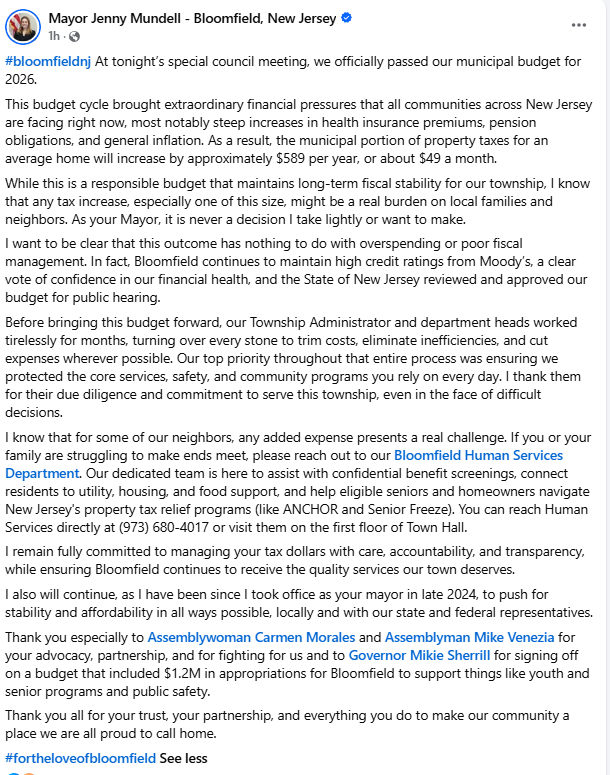
Four words carried this entire budget: outside of local control. They were on the slides, in the press release, and in the administrator’s opening — and every time a resident pushed, on the insurance renewal, the SHBP comparison, the PILOTs, the PR contract, the line items marked only “other,” those four words were there to close the door rather than answer the question. But the costs are statewide and the increase is local: Montclair held under three percent this year, South Orange under four, all facing the same pensions, the same mandates, the same health care market. Bloomfield chose twelve. “Outside of local control” is not an explanation — it is a boundary drawn around a set of choices to keep residents from examining them: who chairs the fund, whether the renewal was shopped, whether the abatements still make sense, whether a $200,000 communications contract outranks the police, fire, and DPW positions this budget cuts. Those are decisions made inside that building, by the people on that dais, and adopted in sixty-eight minutes without one member of the majority explaining one vote. A budget is the clearest statement a government makes about who it answers to. Not to us, residents. This one thing was clear.
Once again, Satenik, an awesome recap of a very upsetting council meeting. I cheered each and every speaker, all of whom were well spoken and well researched and made excellent points and suggestions. And then Jonathan Meijia saying exactly what we were all thinking: what was the point of the pointless exercise of the public comments section when the Mayor and council have proven many times over that whatever residents have to say falls on deaf ears. Whatever is on the agenda is a done deal. Only 2 people on that dais are listening. Well, more and more of us are paying attention.
Hey! I own the sage green and white house in the hero image (#25). I recently renovated the house and did a bunch of work, both inside and outside, to help flood-proof it and reduce the amount of runoff into the sewer system. I hope to eventually work with the town to incentivize this type of work in this neighborhood. Let me know if you want to chat! Cheers